Railways Through the Walls: How Queen Street Changed York
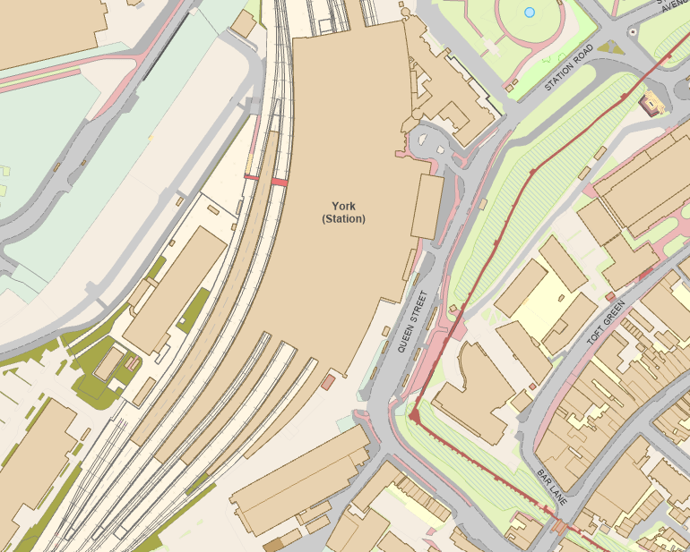
Standing on Queen Street today, it is easy to see how dramatically York's medieval walls were altered by the arrival of the railway. The two large arches which connect the Station to Love Rose Street are not medieval gateways. They are Victorian additions, created when one of the greatest technological innovations of the nineteenth century arrived in York.
In 1839, the York and North Midland Railway opened York's
first permanent railway station immediately inside the city walls. The scheme
was championed by George Hudson, the influential railway promoter who became
known as the "Railway King". Hudson believed that passengers should
be delivered as close as possible to the heart of the city, allowing easy
access to York's inns, hotels and businesses.
Bringing trains into the city centre, however, created a
major challenge. York's walls had protected the city for centuries and were
among its most important historic landmarks. To reach the new station, openings
had to be pierced through the ancient defences. In 1839 the first arch was
created to carry passenger trains, and in 1845 a second arch was added for
goods traffic. The work was designed by York architect George Townsend Andrews
and involved substantial rebuilding of the medieval fabric. Stone-faced brick
arches were inserted into the wall, creating the striking structures that
remain visible today.
Although controversial, the changes reflected the enormous confidence of the railway age. Across Britain, railways were reshaping towns and cities, and York was becoming one of the country's most important railway centres.
A Station Inside the Walls
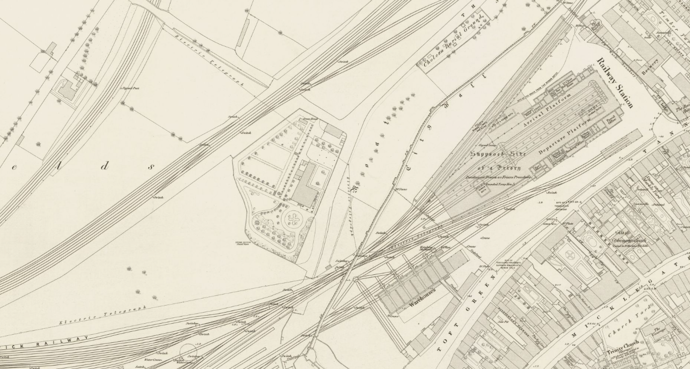
The location of York's first station soon revealed its
limitations. Space was restricted and trains could not easily pass through the
terminus. Instead, locomotives and carriages often had to be shunted in and out
beneath the arches, a process that was slow and increasingly impractical as
passenger numbers grew.
As railway traffic expanded, a larger and more efficient
station became essential. In 1877 a new station was opened to the west of the
walls and outside the historic city boundary. This is the station which is used
today. The following year, passenger services transferred to the new station,
which remains York's main railway station today.
The move marked a significant change in the relationship between the city and its railways. Instead of bringing trains into the confined space within the walls, the new station provided room for expansion while maintaining direct connections to the national rail network.
The Arrival of Queen Street Bridge
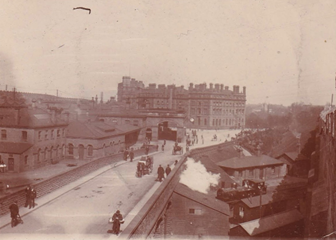
Despite the transfer of passenger services, the old station site continued to play an important role. Goods traffic remained within the former station complex and freight trains continued to pass through the arches for many decades.
To improve movement across the railway lines, Queen Street
Bridge was constructed in 1877. Carrying road traffic above the tracks, the
bridge became a familiar part of York's streetscape. For generations, however,
it also obscured the railway arches from public view. What had once been a
dramatic intervention in the medieval wall became a largely hidden feature,
known mainly to railway historians and those who worked in the area.
The old station itself survived and found new uses after its
railway role ended. Today the building remains standing and serves as offices,
providing a rare surviving link to York's earliest railway era.
A Landscape of Constant Change
The area around York station has never stood still. During
the nineteenth century, open land outside the walls was transformed by railway
tracks, goods facilities, workshops and warehouses. As York developed into a
major railway centre, the landscape was repeatedly adapted to meet changing
transport needs.
Many of the former railway workshops that can still be seen
nearby were built as part of this expanding railway infrastructure. Their
position reflects the routes once taken by trains entering and leaving the
station through the Queen Street arches.
Throughout the twentieth century the area continued to
evolve. Freight operations were reorganised, railway buildings were demolished
or repurposed, and roads were altered to accommodate growing traffic. In 1966
the remaining goods traffic was transferred to facilities associated with the
newer station, allowing the tracks through the arches to be removed. Yet even
without trains, the bridge and surrounding road network continued to shape how
people experienced this part of the city.
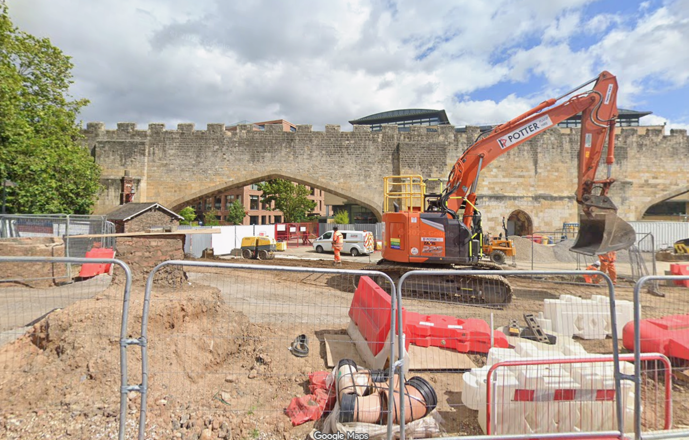 Revealing the Arches Once Again
The latest chapter in this long story began in the
twenty-first century. As part of wider regeneration and transport improvement
schemes, Queen Street Bridge was removed in 2024. For the first time in almost
150 years, the railway arches were once again revealed as a prominent feature
of the city walls.
The removal of the bridge created an opportunity to
reconnect people with an important but often overlooked part of York's history.
What had been hidden behind Victorian and twentieth-century infrastructure
could once again be appreciated as evidence of the moment when medieval York
adapted to the railway age.
The works carried out between 2024 and 2026 represent the
latest phase in a long sequence of changes at Queen Street. Over nearly two
centuries the site has been reshaped by the arrival of railways, the growth of
industry, the demands of road traffic and, most recently, efforts to create a
more accessible and attractive gateway to the city. Each generation has left
its mark on the landscape.
Today, as visitors arrive in York, they encounter a place
where Roman foundations, medieval defences, Victorian engineering and
twenty-first-century regeneration meet. The arches in the city wall are a
reminder that York's historic environment has never been frozen in time.
Instead, it has continually adapted to changing needs while preserving visible
traces of its past.